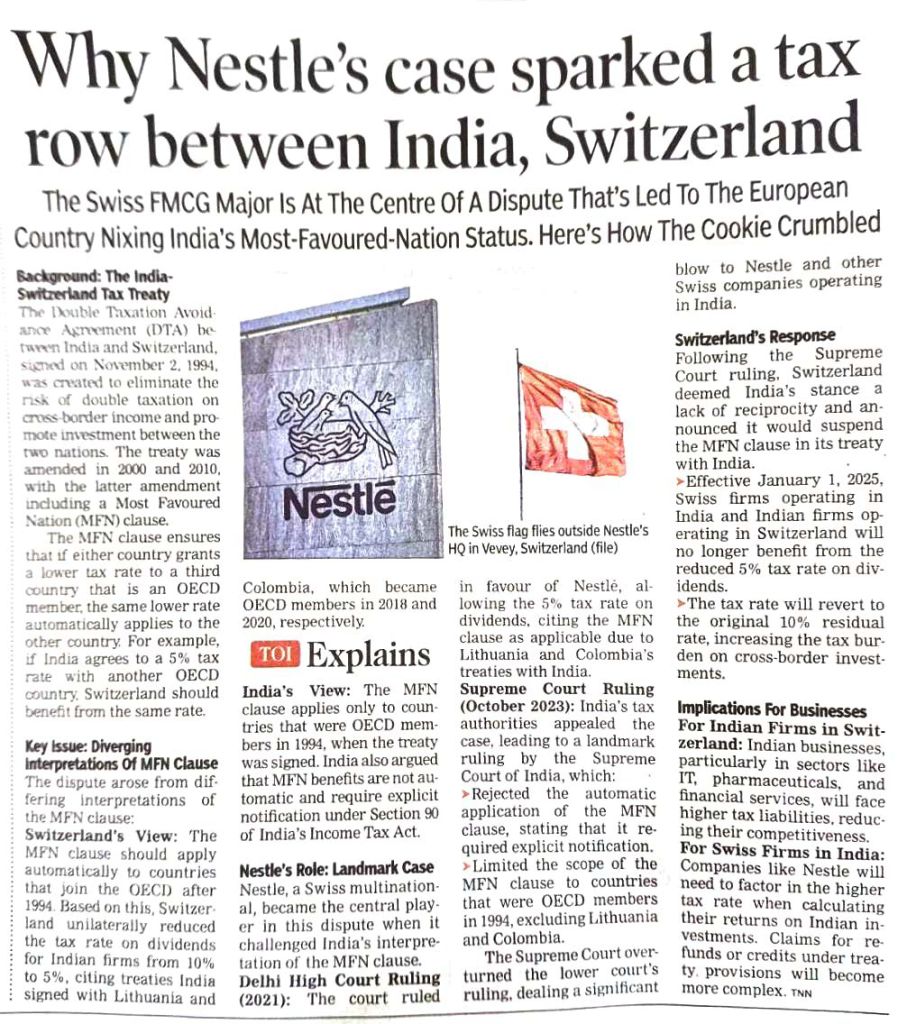
The Swiss government has suspended the most-favoured nation status (MFN) clause in the Double Taxation Avoidance Agreement (DTAA) between India and Switzerland, potentially impacting Swiss investments in India and leading to higher taxes on Indian companies operating in the European nation.
The Swiss FMCG major is at the centre of a dispute that has led to the European Country nixing India’s Most-Favoured-Nation (MFN) status.
•The Double Taxation Avoidance Agreement (DTA) between India and Switzerland signed on 2nd Nov 1994
•DTA is to avoid double taxation on cross border income
•The treaty was amended in 2000 and 2010. In 2010 amendment, MFN clause was included
•MFN clause simply means that if either country grants a lower tax rate to a third country that is an OECD member, then same lower rate automatically applies to the other country.
☆ Key Issue:
■Diverging interpretation of MFN clause
■The dispute arose from differing interpretations of MFN clause
• Switzerland View:
•The MFN clause should apply automatically to countries that join the OECD after 1994
Based on this, Switzerland unilaterally reduced the tax rate on dividends for Indian firms from 10% to 5%, citing treaties India signed with Lithuania and Columbia, which became OECD in 2018 and 2020 respectively
• India’s View:
•The MFN clause applies only to countries that were OECD members in 1994, when treaty was signed.
•India also argued that MFN benefits are not automatic and require explicit notification under section 90 of India’s Income Tax Act
☆ NESTLE’S ROLE: LANDMARK CASE
Nestle, a Swiss multinational, became the central player in this dispute when it challenged India’s interpretation of the MFN clause
☆ Delhi High Court Ruling (2021):
The court ruled in favour of Nestle, allowing the 5%tax rate on dividends, citing MFN clause as applicable due to Lithuania and Columbia’s treaties with India
★ Supreme Court ruling (October 2023):
India’s tax authorities appealed the case, leading to a landmark ruling by Supreme Court of India, which:
- Rejected automatic application of the MFN clause, stating that it required explicit notification
Limited the scope of the MFN clause to countries that were OECD members in 1994, excluding Lithuania and Columbia
The Supreme Court overturned the ruling of High Court dealing a significant blow to Nestle and other Swiss comoanies operating in India.
SWITZERLAND RESPONSE
Unhappy with Supreme Court Ruling, Switzerland deemed India’s stance a lack of reciprocity & announced to suspend MFN clause in it’s treaty with India
Effective 1st January 2025, Swiss firms operating in India and Indian firms Operating in Switzerland will no longer benefit from the reduced 5% tax rate on dividends
- The tax rate will revert to original 10% residual rate, increasing the burden on cross border investments
IMPLICATIONS FOR BUSINESSES:
■For Indian firms in Switzerland:
Indian businesses, particularly in sectors like IT, pharmaceuticals, and financial services, will face higher tax liabilities, reducing their competitiveness.
■For Swiss firms in India:
Companies like Nestle will need to factor in the higher tax rate when calculating their returns on Indian investments. Claims for refunds or credits under treaty provisions will become more complex
MY COMMENTS:
After Delhi High Court Ruling in 2021 and later after Supreme Court ruling in 2023, there were several discussion had been made about this case. I had opined that SC was right in rejecting Delhi High Court Ruling.
~Navneet Shukla
 TaxxPlanet
Leave a comment